

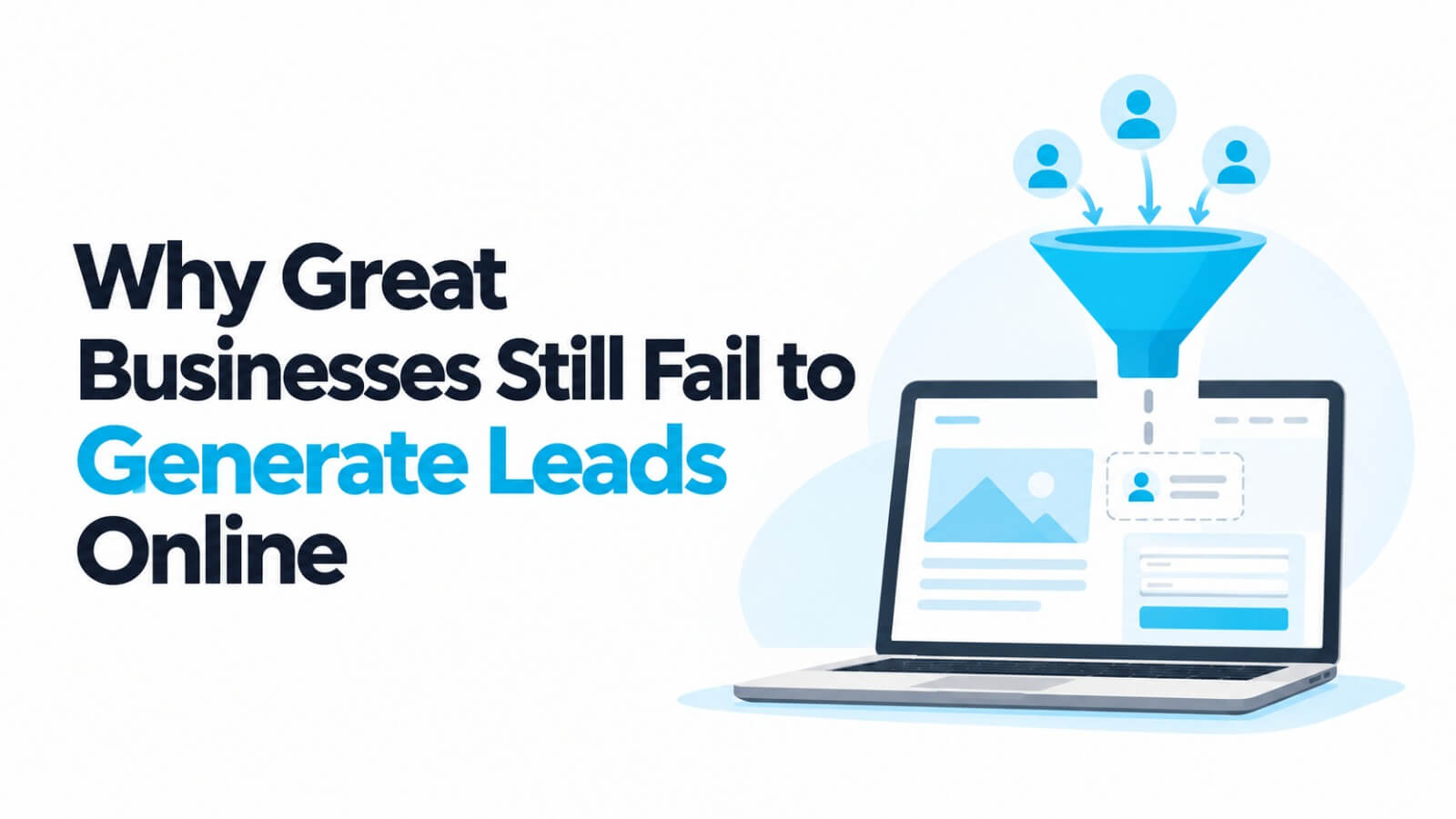
A business can have a genuinely strong product, an experienced team, satisfied customers, and a well-designed website, and still struggle to generate a consistent flow of enquiries online. This is more common than most business owners realise, and it rarely has anything to do with the quality of what they offer.
It’s tempting to assume that if the product is good enough, customers will eventually find their way to it. But that assumption misunderstands how online lead generation actually works. Being good at what you do and being easy to discover, understand, and choose online are two separate systems. A business can excel at one and still fail at the other.
This gap explains why so many companies that are investing time and money into marketing still ask the same question: why aren’t we getting enough leads? The answer is rarely a lack of effort. It’s usually a disconnect somewhere between audience, message, experience, and follow-up, one that more advertising spend alone won’t fix.
Being Good at What You Do Is Not Enough
Quality builds reputation. It does not build visibility. A business can be the best at what it does in its city or category and still be invisible to the people searching for exactly that service, simply because it hasn’t been positioned to appear when those searches happen.
Customers cannot choose a business they never encounter, and they cannot trust a business whose value they don’t immediately understand. This is where many good businesses quietly lose ground. Their competence shows up in the work they deliver, not in the thirty seconds a potential customer spends deciding whether to click, call, or move on.
Online lead generation for businesses starts long before someone experiences the quality of the product. It starts with whether the business shows up in the right place, at the right moment, with a message that makes sense immediately.
Reaching People Is Not the Same as Reaching Potential Customers
A campaign can generate thousands of impressions and still produce almost no enquiries. This confuses a lot of business owners, especially when the numbers on a dashboard look healthy.
Reach measures how many people saw something. It says nothing about whether those people were in a position to buy. A premium interior design company might generate strong engagement from people who simply enjoy looking at beautiful homes, without ever reaching someone who is actively planning a renovation. The attention is real, but it never converts into a lead, because the audience wasn’t the right one to begin with.
This is the core difference between traffic and intent. Traffic tells you people are looking. Intent tells you they are close to a decision. Lead generation campaigns that are built around traffic alone will always underperform against campaigns built around intent, even with a fraction of the budget.
The Offer May Be Strong, But the Message Is Weak
Many businesses have a genuinely strong offer that gets lost in generic communication. Messaging that lists features instead of outcomes, or that tries to appeal to everyone, usually ends up meaning little to anyone.
A B2B software company might have a genuinely useful product, but if its website talks about “streamlining operations” without explaining what that means for a specific type of buyer, a visitor has no reason to act. The same applies to a healthcare clinic that lists its services without addressing the actual concerns a patient has before booking an appointment.
Strong offers need equally specific messaging. Vague positioning doesn’t just fail to attract leads, it actively repels the ones who were close to a decision, because it gives them nothing concrete to respond to.
The Website Is Getting Traffic, But Not Conversions
Traffic without conversion is one of the most common and least understood problems in online marketing. A business can rank well, run effective ads, and still watch visitors leave without taking action.
The reasons are usually structural rather than dramatic. A call to action that’s unclear or buried. A landing page that makes a visitor scroll too far before understanding what’s being offered. Missing trust signals, such as reviews, credentials, or clear pricing information. Slow load times. Confusing navigation that makes it hard to find the one thing a visitor came for.
None of these problems are visible from the outside. A business owner sees a professional-looking site. A visitor experiences friction they can’t quite name, and leaves. This is why website conversion deserves as much attention as the traffic driving people to the site in the first place.
Content Is Being Created Without a Customer Journey
Posting regularly is not the same as having a content strategy. Many businesses treat content as a box to tick, publishing consistently without asking what each piece is actually meant to do.
Effective content serves a stage. Some content should build awareness among people who don’t yet know they have the problem. Some should help people compare options once they’re actively considering a purchase. Some should build trust, through case studies, testimonials, or detailed explanations. And some should exist purely to move a ready buyer toward a decision.
A real estate business might post consistently about market trends, which builds awareness, but never publish anything that helps a serious buyer understand the actual purchase process, which is what would move them toward an enquiry. The content looks active. It isn’t doing the job that generates leads.
Marketing Without Proper Targeting
Broad targeting feels safer. It also wastes budget faster than almost any other mistake in digital marketing.
Many businesses target based on who they assume their customer is, rather than who is actually showing buying signals. An education business offering exam preparation courses might target “students” broadly, when the real decision-makers are often parents actively searching for a specific outcome. A local service business might target an entire city, when its actual customers are concentrated in a handful of neighbourhoods.
Precise targeting isn’t about reaching fewer people. It’s about reaching the right ones, with an offer that’s relevant to their specific situation. That relevance is what turns a viewer into an enquiry.
Businesses Often Measure the Wrong Things
Vanity metrics feel good. Likes, followers, and impressions are easy to see and easy to celebrate, but they rarely tell a business owner whether marketing is actually working.
The metrics that matter for a lead generation strategy are enquiries, qualified leads, conversion rate, and cost per acquisition. A professional services firm might have a growing social media following and still be losing money on campaigns that never translate into client meetings. The follower count looks like progress. The bank account tells a different story.
This doesn’t mean vanity metrics are useless. They can indicate brand awareness and audience interest. But they should never replace the numbers that actually reflect business outcomes.
There Is No Real Testing or Optimisation
Digital marketing is not a one-time setup. A campaign that performs well in its first month can quietly decline in its third, and a business that isn’t testing won’t notice until the results have already dropped.
Ad creatives lose effectiveness as audiences see them repeatedly. Landing pages that convert well for one audience segment may perform poorly for another. Offers that felt compelling six months ago may no longer match what customers are comparing. Without ongoing testing across creatives, audiences, offers, and messaging, even a well-built campaign gradually loses effectiveness.
This is one of the more overlooked reasons businesses fail to generate leads online. It’s not that the original strategy was wrong. It’s that nobody kept adjusting it as conditions changed.
Marketing and Sales Are Working Separately
Even a well-executed campaign can fail to generate real business results if marketing and sales are disconnected. A lead that isn’t followed up quickly, or is handled inconsistently, often stops being a lead altogether.
An e-commerce business might run highly targeted campaigns that generate genuine interest, only to lose the sale to slow customer service response times. A B2B company might generate qualified enquiries that go unanswered for days, by which point the buyer has already spoken to a competitor. The marketing did its job. What happened after is where the value was lost.
This disconnect is common because marketing and sales are often treated as separate functions with separate goals, when they need to function as one connected system.
Diagnosing the Real Gap
Successful online lead generation depends on a complete chain working together: the right audience, the right message, the right channel, the right offer, the right experience, and the right follow-up, all of it measurable.
When leads aren’t coming through, the instinct is often to spend more. Increase the ad budget, post more content, run another campaign. But without knowing which part of the chain is actually broken, additional spend usually just amplifies the same problem faster.
A business generating traffic but no conversions has a website or offer problem, not a reach problem. A business generating enquiries that don’t turn into clients has a sales alignment problem, not a marketing problem. Identifying where the actual gap exists, before increasing investment, is what separates businesses that fix their lead generation from those that keep spending without results.
The Real Reason Businesses Struggle
Most businesses that fail to generate leads online are not failing because of poor products or lack of effort. They’re failing because of gaps between strategy, targeting, messaging, conversion, and measurement, gaps that are rarely visible from inside the business.
This is where a clear, strategic approach to digital marketing matters more than simply doing more of it. At Beeka, this is often the starting point with businesses that come in already investing heavily in marketing but not seeing the results to match. The work isn’t about adding more activity. It’s about finding where the system is actually breaking down, and rebuilding it so each part, audience, message, experience, and follow-up, works together toward a measurable outcome.
A good business deserves a lead generation system that reflects its quality. Building one requires treating marketing as a connected process, not a series of disconnected efforts.